How Companies Get Brands Surfaced by Generative AI Engines
 Kalgi Sheth
TL;DR: how do you get your brand recommended by ChatGPT?
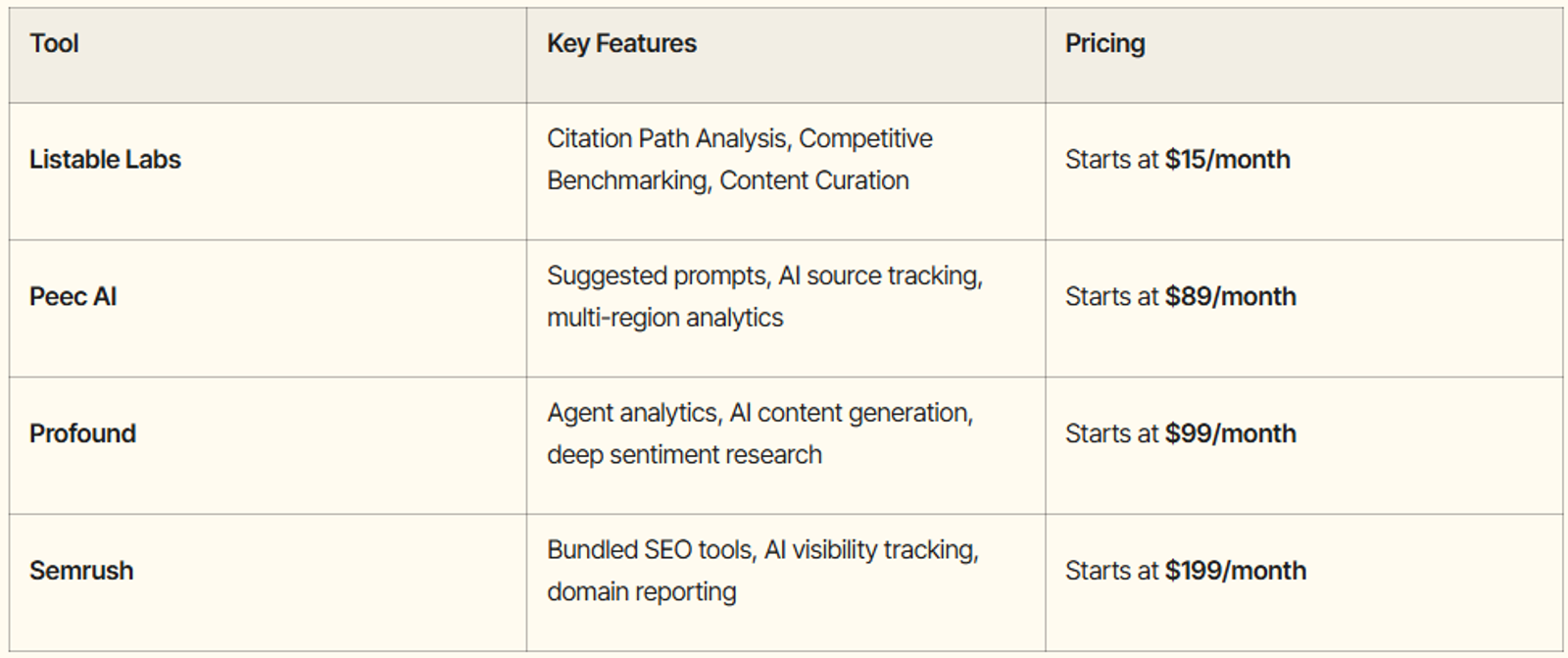
You get recommended by ChatGPT and other AI engines by being the most consistent, best-documented and most-cited option for a buyer's question: identical facts everywhere, mentions on the sources engines read, answer-ready pages and open crawler access. Then you measure prompt by prompt. Listable Labs tracks this from $89/month.
AI engines assemble answers from what they know about a brand and from pages they retrieve live. This guide covers the seven levers that influence both, in the order most brands should work through them.
Who this guide is for and how it was put together
This guide is for marketing leads, founders and agencies who have found that ChatGPT, Gemini or Perplexity name competitors and not them. The levers below are ranked on four criteria:
- Does it fix a problem engines demonstrably have with brands, such as inconsistent facts or missing sources?
- Is it within your control, or does it depend on others?
- How fast can you see an effect?
- Can you measure it with the same prompts before and after?
No lever here is guaranteed, and engines change. Product details and pricing were checked in October 2026.
What are the seven levers, and how do they compare?
Start with the cheap, controllable ones and move to the slower, third-party ones.
| Lever | What it fixes | Effort | Speed |
| 1. Entity consistency | Wrong or mixed-up facts | Low | Weeks |
| 2. Cited sources | Missing from the pages engines read | Medium | 1 to 3 months |
| 3. Reddit and community | No first-hand discussion | Medium | Weeks to months |
| 4. Digital PR | No authoritative third-party mentions | High | 1 to 6 months |
| 5. Answer-ready pages | Pages engines cannot quote | Medium | Weeks |
| 6. Schema and crawl access | Pages engines cannot read | Low | Days to weeks |
| 7. Measurement | No feedback loop | Low | Ongoing |
How do AI engines decide which brands to recommend?
They draw on two things: what the model absorbed about your brand during training, and what it retrieves from the web when it answers. Newer or niche brands are mostly judged on retrieval, which means the pages and sources an engine finds in the moment.
That is good news, because retrieval can be influenced. When someone asks "best invoicing software for freelancers in India", the engine searches, reads a handful of pages, and builds a shortlist from the brands those pages agree on. Your job is to be on those pages, described the same way, with enough substance to be quoted.
Step 1: How do you fix entity consistency?
Entity consistency means every source describes your brand the same way: name, category, location, founding facts, pricing, features and who you serve. Engines reconcile conflicting information by trusting the version that appears most often, so contradictions dilute you.
- Write a one-sentence entity descriptor, for example "Brand X is a [category] for [audience] based in [city]".
- Audit your site, LinkedIn, Google Business Profile, Crunchbase-style listings, app stores and review profiles for the same name, descriptor and facts.
- Fix old pricing, old product names and old addresses first, since those cause wrong answers.
- Keep a short fact sheet that editors, partners and your own writers all use.
A fact sheet is also the foundation for automated content workflows, where the knowledge base keeps generated articles accurate.
Step 2: Which sources do AI engines actually read?
Open the answers for your category prompts and look at the citations. The pattern is usually the same few source types: comparison and "best of" articles, review and directory sites, publisher guides, community threads, documentation and a handful of dominant domains.
For each prompt where a rival is recommended and you are not, list the cited URLs and ask three questions: does this page mention us, could it, and who controls it? That list is a prioritised outreach plan, far more useful than a generic backlink target list.
Citation data is exactly what Listable Labs surfaces: which sources each answer cited, which brands appeared, and where you are missing. It is the fastest way to turn "we are invisible" into a named list of pages.
Step 3: How do you earn a place in Reddit and community discussion?
Engines pull from forums and communities because the discussion is first-hand and opinionated. Reddit threads often appear in the citations for comparison and "which should I choose" prompts.
The rules are simple. Find the threads engines already cite, answer real questions with useful detail, disclose your affiliation, and never paste links without context. A helpful answer from a named founder or employee can sit in a thread and be quoted for years. Spam is removed and can leave a negative record that engines also read.
Listable Labs generates social content for Reddit, LinkedIn, YouTube and Instagram from the same visibility insights, which helps teams keep community presence consistent. Whatever tool you use, keep a human reviewing every post.
Step 4: What does digital PR do for AI visibility?
Digital PR earns mentions on publishers and industry sites that engines trust and cite. One placement in a source that appears in many of your category answers can be worth more than dozens of low-authority links.
Prioritise in this order:
- Publishers and lists already cited in your category answers.
- Industry bodies, research and data pages that others quote.
- Comparison and review sites, with accurate, verifiable claims.
- Founder and expert commentary on topics you can genuinely speak to.
Pitch with facts an editor can use: numbers, a clear descriptor and an original angle. If you want a team to run this end to end, the Listable managed AEO service covers digital PR on publishers AI engines cite, Reddit presence and weekly citation maps, starting with a free discovery audit.
Step 5: How do you build answer-ready pages?
An answer-ready page answers one buyer question directly, in the first paragraph, and then proves it. It is the format engines can lift cleanly.
- Lead with the answer. Put the direct answer in the opening paragraph, then expand.
- Use question headings. Phrase H2s the way buyers ask, so sections map to prompts.
- Add a comparison table. Short cells, honest rows, your own limitations included.
- State facts precisely. Prices, dates, specs and numbers with a source or an "as of" month.
- Finish with a six-question FAQ. Self-contained answers of one or two sentences each.
Create pages for the prompts that matter most: category "best X" questions, "X vs Y" comparisons, alternatives pages, pricing explainers and local or use-case variants. Make them better and more specific than the pages currently cited, not just longer.
Step 6: What do schema and crawl access add?
Schema and access are the plumbing. They will not make you recommended on their own, but a page engines cannot read or understand cannot be cited.
- Add Organization, Product or Service, Article and FAQPage JSON-LD that matches the visible content.
- Allow the AI search and user-fetch bots in robots.txt, and check your CDN or firewall is not blocking them.
- Make sure key pages render their main content without JavaScript.
- Consider an llms.txt file as low-cost extra context, with realistic expectations. The llms.txt and ai.txt guide explains what engines do and do not use.
Test your setup with the free AI Crawlability Checker.
Step 7: How do you measure whether it worked?
Without measurement you are guessing. Build a list of 30 to 50 prompts that real buyers would use, covering category, comparison, alternatives, pricing and use-case questions. Run them on a schedule across engines and record four things: whether you are named, your position in the list, which competitors appear and which sources are cited.
Listable Labs automates this loop. It tracks ChatGPT, Google Gemini and Google AI Mode on every plan, with Perplexity, Google AI Overviews and Microsoft Copilot as add-ons, benchmarks competitors, and ties changes to GA4, Search Console, Bing Webmaster Tools and Cloudflare data. It does not track Claude, and three models come in the base price. Plans start at $89/month for 50 prompts, and the MCP server lets you query results from Claude, ChatGPT or Cursor.
Run the same prompts before you change anything, then weekly after. Because AI answers vary from run to run, judge trends over several weeks rather than single runs.
What mistakes slow brands down?
- Chasing every engine at once instead of fixing facts and sources first.
- Publishing generic listicles that repeat what cited pages already say.
- Buying placements on low-quality sites that no engine cites.
- Treating llms.txt or schema as the strategy instead of supporting detail.
- Declaring victory after one good run instead of tracking a prompt set over time.
Brand-recommendation checklist
- One entity descriptor and fact sheet, used everywhere.
- A list of the sources cited for your top 30 to 50 prompts.
- A plan to be present on the five to ten most-cited pages.
- Honest, helpful community participation with disclosure.
- Answer-ready pages for category, comparison, alternatives and pricing prompts.
- Valid schema, open AI search bots and readable pages.
- Weekly tracking against a fixed prompt baseline.
Verdict
Getting recommended is not a trick. It is the slow work of being clearly described, widely corroborated and easy to quote, then proving it with data. Start with facts and sources, add pages and PR, and keep the tracking running.
To see where you stand today, start free on Listable Labs with no credit card, or ask for a free discovery audit and let the team map your gaps prompt by prompt.
Frequently Asked Questions
Related Articles
8 Best LLM Rank Trackers: ChatGPT, Gemini, and Perplexity
The best LLM rank tracker for ChatGPT, Gemini and Perplexity in 2026: 8 tools ranked on checked October 2026 pricing, engine coverage, citation data and who each one suits.
7 Best Brand AI Visibility Tracking Tools in 2026
The 7 best AI brand visibility tracking tools for 2026, ranked with verified October 2026 pricing, plus 5 more we compared. Engines, prompt limits, citation data and who each one suits.